

Bagasse Tableware Making Machine Price in India 2026: Complete Cost Guide
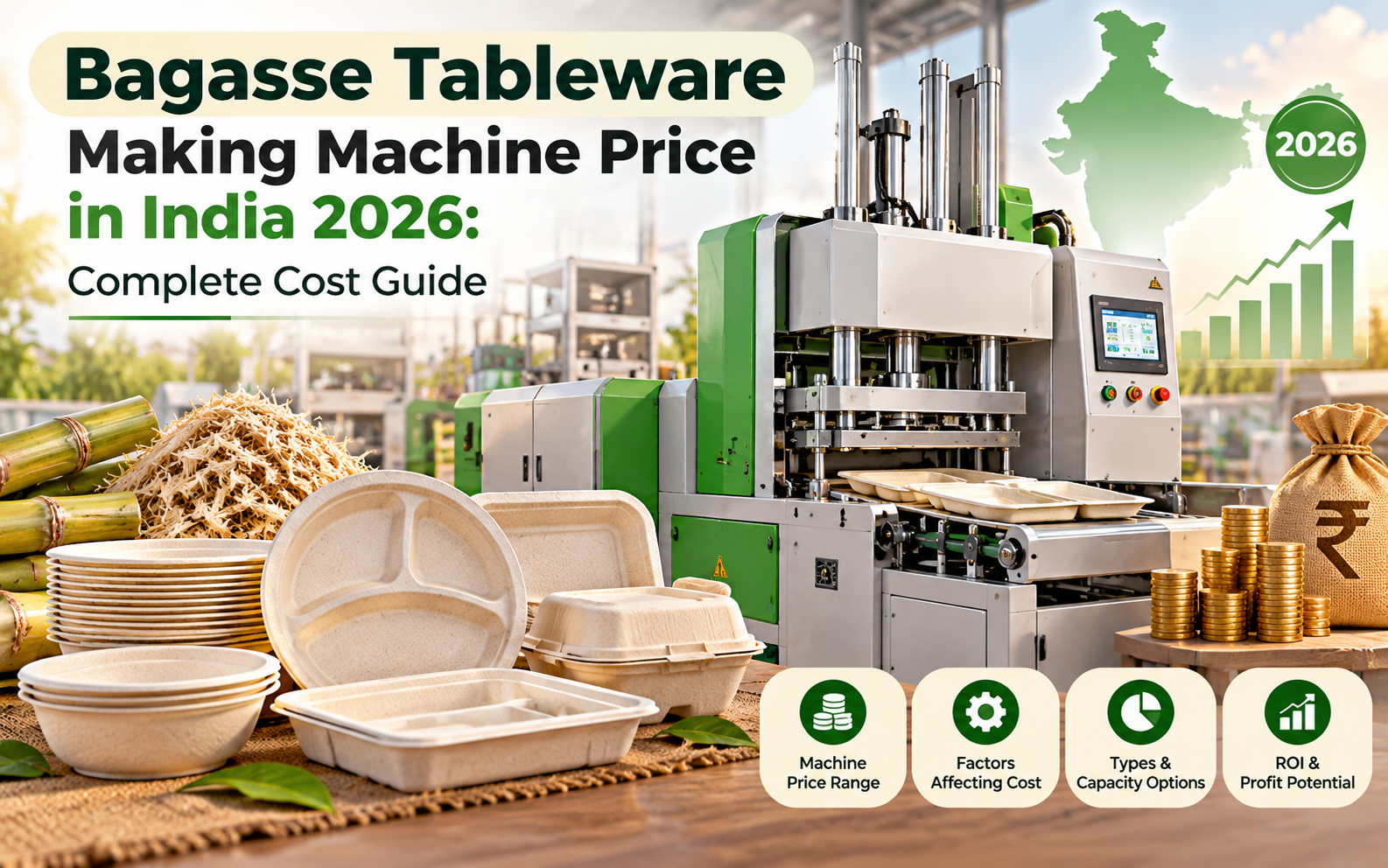
Table of Contents
-
Introduction to Bagasse Tableware Manufacturing
-
Bagasse Tableware Making Machine Price in India in 2026
-
Factors That Affect Machine Prices
-
Additional Costs of Setting Up a Manufacturing Unit
-
How to Choose the Right Machine
-
Frequently Asked Questions
1. Introduction to Bagasse Tableware Manufacturing
The demand for sustainable food packaging has encouraged businesses to explore alternatives to conventional plastic and foam tableware. Sugarcane bagasse, the fibrous residue left after extracting juice from sugarcane, is widely used to manufacture disposable plates, bowls, trays, and food containers.
Bagasse tableware is generally produced by processing sugarcane fibre into pulp, forming the pulp into the required shape using moulds, and drying and finishing the products. The finished tableware can serve restaurants, catering companies, food delivery businesses, event organisers, and packaging distributors.
For entrepreneurs planning to enter this sector, understanding the cost of a manufacturing machine is an essential first step. However, the total investment depends on more than the machine itself. Production capacity, raw materials, moulds, electricity, labour, factory space, and quality control also influence the project’s financial requirements.
A well-planned investment begins with evaluating market demand, selecting suitable equipment, and estimating the complete cost of production rather than focusing exclusively on the initial purchase price.
2. Bagasse Tableware Making Machine Price in India in 2026
The price of a bagasse tableware manufacturing machine depends on its production capacity, automation level, mould configuration, and included processing equipment. As a practical starting point, publicly listed Indian supplier prices provide useful reference points, although the final quotation may differ by model and configuration.
-
Semi-automatic machine: One supplier lists a bagasse tableware machine at approximately ₹45 lakh.
-
Fully automatic machine: Listed prices for automatic production equipment range from approximately ₹1.10 crore to ₹1.25 crore.
-
Integrated manufacturing line: A complete setup that includes pulp preparation, forming, drying, finishing, and supporting utilities may require a substantially larger investment.
These are indicative supplier-listed prices, not guaranteed market-wide rates. You can review specifications on Greenland International’s machine listing and published automatic machine listings.
When comparing equipment, avoid treating all plate-making machines as equivalent. A conventional paper plate making machine may be designed for paperboard blanks, whereas bagasse tableware equipment generally uses a moulded-pulp process. Their raw materials, tooling, production methods, and investment requirements can be significantly different.
Similarly, the paper plate making machine price in india varies according to whether the equipment manufactures ordinary coated-paper plates or moulded-fibre products. Always confirm that the quoted machine is suitable for the exact bagasse products you intend to manufacture.
3. Factors That Affect Machine Prices
Several technical and commercial factors determine the final purchase cost.
Automation and production capacity: Fully automatic equipment can reduce manual handling and support consistent output, but it usually requires a higher initial investment. Evaluate the realistic hourly output for your selected plate size instead of relying solely on the manufacturer’s maximum capacity.
Mould design and product range: Round plates, compartment plates, bowls, trays, and takeaway containers may require different moulds. Additional tooling can increase the initial cost, so confirm the number of mould sets included in the quotation.
Pulp preparation and drying: Some machines process prepared pulp, while integrated lines include additional equipment for stock preparation, water handling, forming, and drying. The required configuration directly affects the budget.
Power consumption and maintenance: Heating systems, hydraulic components, vacuum pumps, and compressors contribute to operating expenses. Check installed power, actual consumption, spare-part availability, and service support before selecting a machine.
A disposable plate making machine should therefore be evaluated on total ownership cost, production consistency, and suitability for the target market—not just its purchase price.
4. Additional Costs of Setting Up a Manufacturing Unit
The machine price is only one part of the investment. Entrepreneurs should also budget for the following expenses:
-
Factory space and installation: Flooring, electrical connections, ventilation, drainage, and machine foundations.
-
Raw materials: Bagasse pulp, process additives, and packaging materials.
-
Utilities: Electricity, water, compressed air, and waste management.
-
Labour and training: Machine operators, quality inspectors, packaging staff, and maintenance technicians.
-
Working capital: Funds for inventory, salaries, transportation, customer credit, and day-to-day operations.
For instance, a supplier quotation for a ₹45 lakh machine does not mean the business can begin production with ₹45 lakh alone. Installation, additional equipment, tooling, and operating funds must be assessed separately.
When estimating the sugarcane bagasse plates making machine price in india, request a detailed quotation that clearly distinguishes the machine cost from the complete project cost.
5. How to Choose the Right Machine
Start by identifying your target customers and the products they require. Restaurants may prefer standard plates and bowls, while food delivery companies may need compartment trays and containers.
Compare suppliers on production capacity, product quality, energy efficiency, warranty, installation, training, and after-sales service. Ask for a live production demonstration and samples made using the proposed equipment.
A suitable paper moulding machine should deliver consistent thickness, shape, strength, and finishing while minimising material waste. Also verify whether the quoted system includes moulds, pulp preparation, drying, and water-recycling facilities.
If sustainability is central to your business, an Eco-Friendly Disposable Plate Making Machine should be assessed alongside the finished products’ actual material composition, food-contact suitability, and applicable compostability requirements. Environmental claims should be supported by appropriate testing and certification.
Finally, select a Disposable Machine Making Manufacturer with verifiable installation experience, accessible spare parts, technical support, and transparent commercial terms. Obtain written confirmation of output capacity, electricity requirements, delivery timelines, and warranty coverage before placing an order.
Conclusion
Investing in bagasse tableware manufacturing can offer a business opportunity for entrepreneurs targeting sustainable food packaging. However, the right investment depends on product demand, machine performance, operating costs, and the supplier’s reliability. Compare complete project costs rather than machine prices alone, and build a realistic financial plan before starting production.
Frequently Asked Questions
1. What is the price of a bagasse tableware making machine in India in 2026?
Indicative supplier listings show semi-automatic equipment at around ₹45 lakh and certain fully automatic models at approximately ₹1.10 crore to ₹1.25 crore. Actual prices depend on specifications, tooling, and included equipment.
2. Can I start a bagasse plate manufacturing business with a small budget?
Yes, but the budget must cover suitable machinery, raw materials, installation, labour, utilities, and working capital. Obtain quotations for a production setup matched to your available investment.
3. What raw materials are required for manufacturing bagasse tableware?
The primary material is processed sugarcane bagasse pulp. Depending on the product and formulation, manufacturers may also require approved additives, water, and packaging materials.
4. How do I calculate the profitability of a bagasse tableware business?
Calculate the cost per saleable unit, including raw materials, electricity, labour, packaging, maintenance, and wastage. Compare this with the actual selling price and expected sales volume. Profitability depends on capacity utilisation, market demand, and operating efficiency.
5. What should I check before purchasing a manufacturing machine?
Verify production capacity, power consumption, mould compatibility, product quality, warranty, installation costs, spare-part availability, and after-sales support. Request a written quotation and product samples before making your final decision.


